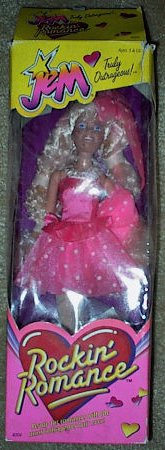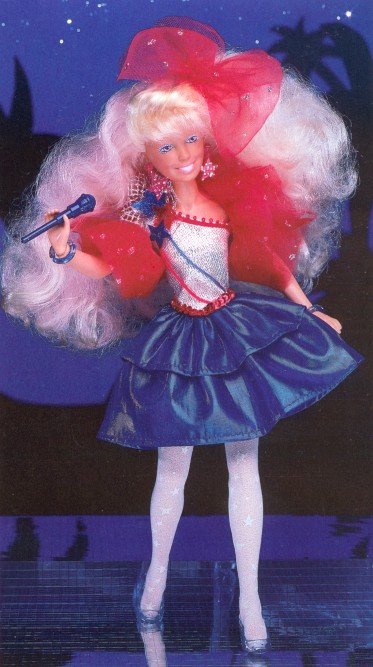
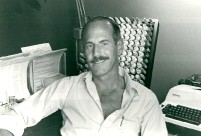
 The original concept of the Jem doll line, was an idea by Bill Sanders, a famous award winning advertising executive
and art director, Joe Hyland, who had been a marketing director at Hasbro, aswell as his wife Barbara Hyland, a writer.
Bill moved to a boathouse on Casey Key, Florida, where he worked out all the details.
Together the three worked out the concept, characters, fashions and other products.
The ideas, which Hasbro was about to turn into reality, was a line of 12½ inch fully articulated rockstar
dolls with wild hair colors, accompanied by a line of outrageously designed rockstar fashions, and playsets
with built-in real musical features.
The original concept of the Jem doll line, was an idea by Bill Sanders, a famous award winning advertising executive
and art director, Joe Hyland, who had been a marketing director at Hasbro, aswell as his wife Barbara Hyland, a writer.
Bill moved to a boathouse on Casey Key, Florida, where he worked out all the details.
Together the three worked out the concept, characters, fashions and other products.
The ideas, which Hasbro was about to turn into reality, was a line of 12½ inch fully articulated rockstar
dolls with wild hair colors, accompanied by a line of outrageously designed rockstar fashions, and playsets
with built-in real musical features.
To promote these dolls, Hasbro decided to create an animated series. Hasbro brought in their advertising agency Griffin-Bacal Advertising, New York, and Sunbow Productions, a company that was owned by Griffin-Bacal Advertising, and co-produced most of their work with Marvel Productions, and which at the same time was producing cartoons for other major Hasbro toylines like Transformers, G.I. JOE and My Little Pony.
|
||
|
For developing the Jem show, Hasbro was looking for a female writer, someone who also knew how to do
action/adventure. Christy Marx, who had worked for Sunbow for about a year and written several scripts
for G.I. JOE, was approached by Sunbow. Christy was flown to New York to meet with
Sunbow, and she got the job.
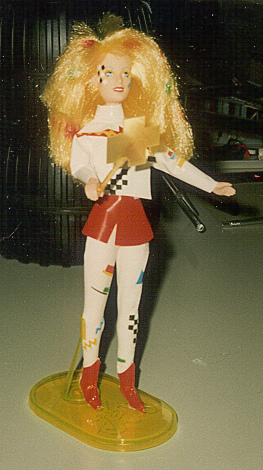
Christy was given polaroids of the doll prototypes aswell as the first names of the
characters from Hasbro.
Hasbro believed that boys control the TV remote, so they wanted Jem to appeal to
both girls and boys, so the boys wouldn't change the channel when Jem came on.
Hasbro asked Christy for fashion, romance, glitter, aswell as action, and music videos
on top of it all. Christy had a difficult task ahead.
This was the first time Christy was able to develop something herself, previously
she had worked on shows with already finished character concepts like Spider-man & His Amazing Friends.
Jay Bacal and the other executives at Sunbow gave Christy the guidelines.
Christy was told that the "Truly Outrageous" rocksinger "Jem" was also someone named "Jerrica",
who has a holographic computer named "Synergy" and holographic earrings which makes Jerrica
become Jem. Jerrica has a boyfriend named Rio, a Roadster, and group of girls in her band
called "the Holograms". "Kimber" is her sister and plays keyboards. A group of bad girls
in another band are called "the Misfits".
Jem's band went through alot of name changes aswell. Some of the early names for the characters were:
Jerrica = Morgan/Joanna. Kimber = Aja. Aja (played drums at first) = Jade.
Shana (played bass guitar at first, and the doll actually
came with a guitar) = Aria, Chandra, Beverly. Roxy = Rue. Stormer = Rue and Roxy.
Christy wasn't looking to only helping Hasbro sell toys, she wanted to write things that were interesting, and create the best characters she could, and come up with good messages. From the very basic information Christy got, she came up with the characters' full names, relationships, who they really were, their strengths and weaknesses, and how they interacted with each other. For the last names of Jerrica, the Holograms and Pizzazz, Christy used the last names of famous scientists who were developing holographic technology at the time. (Jerrica) Benton = Dr. Stephen A. Benton, (Pyllis "Pizzazz") Gabor = Dennis Gabor, and Emmett (Benton) & (Aja) Leith = Emmett Leith. The villain Eric Raymond, was named using the first and middle names of Christy's brother. Christy came up with Jerrica's music company Starlight Music, the Starlight House, the Starlight Foundation and the Starlight Girls and most of the details of the series. The Starlight Foundation was a way to give Jerrica/Jem a noble reason behind what she does and to spin off additional stories. Christy also came up with the Jerrica/Rio/Jem love triangle, and Hasbro loved it. It added a special dimension to the show and made it work also as a soap opera, while it also gave another reason for Jerrica to continue keeping Jem's identity a secret. Christy wrote down all of the details and created the Jem bible, which was a guide for all of the Jem episode writers, and contained all the background information the writers would need to write scripts for Jem. The Jem bible was handed out to writers so they could pitch ideas to Christy and Sunbow. But the Jem show was also going to feature music videos by the two girlbands. So on top of following the guidelines in the Jem bible, the writers needed to make room for two or three songs when writing an episode. They didn't write the songs, but were expected to indicate where the songs would go in each act, and give a rough idea of what the song should be about, what takes place during it, or visuals they thought should go along with the song.
|
||
|
Peter Phillips had worked with the song writer Anne
Bryant for many years, and was told that they were looking for a singer for the
singing voice of Jem, someone who was not a professional “jingle” singer.
He suggested to his daughter Britta Phillips, who was 21 years old at the time, that
she should audition.
They had everyone, who was auditioning, record the Jem theme song, and Britta was chosen as the singing voice
of Jem. The theme song on the show is Britta's audition, she only had to sing it once.
When recording the rest of the music of the series, Ford would sit at the piano with Britta and sing the
song. He and Anne would also fill Britta in on what the corresponding storyline was
for that episode. She would memorize it as quickly as possible and begin recording.
The other main singing voices were done by Ellen Bernfeld who was the singing voice of
Pizzazz of the Misfits, and later in the series also Gordon Grody who was the singing voice of Riot of the Stingers.
Anne Bryant and Ford Kinder did all of the writing of the songs, and Barry Harman wrote the lyrics.
As for the speaking voices, Samantha Newark was signed to an agency in Los
Angeles for commercials, TV and film. The agent
that represented her at this agency left there and started her own agency and
Samantha went along with her. The very first voice-over audition Samantha read for was the
character "Jem", at the voice director Wally Burr's studio.
As fate would have it, she got the lead and became the youngest member of the cast.
|
||
|
The cartoon begins with Jem and the Holograms getting introduced one
by one as they exit a flashy car on the street with fans screaming. Then Jem thinks back on
how it all began after the death of Jerrica's father, when he left behind two inheritances, a
music company, Starlight Music, and a home for foster girls, Starlight House. The foster
home is need of money, but the other half of the music company was left to Eric Raymond, who has
taken complete control of the company and plans to promote troublemaking bands like the Misfits.
Jerrica is left with no money to support the Starlight Foundation and it's foster girls. Until...
a little box arrives in the mail, with a special pair of starshaped earrings, that reveal the best
inheritance of her father, the holographic computer Synergy.
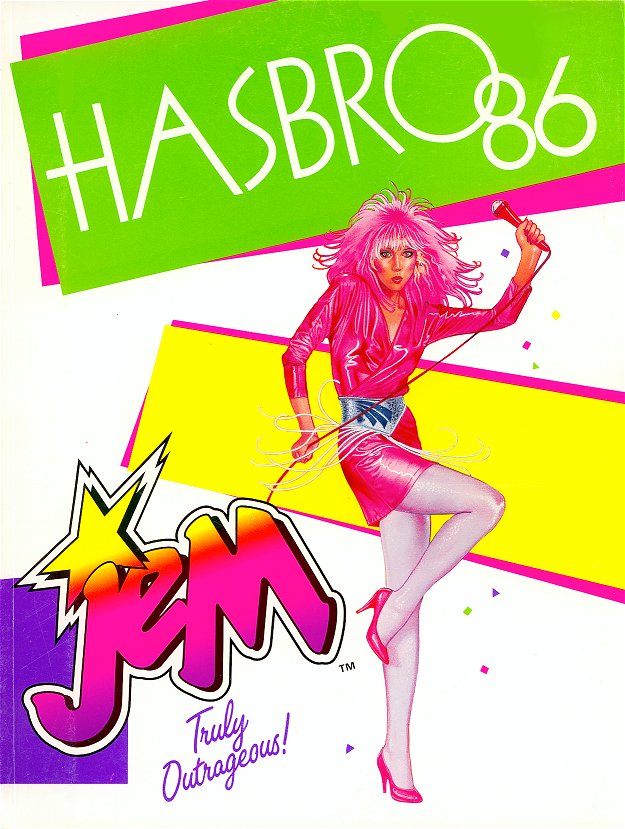
The Jem cartoon was a great commercial for the dolls, and strengthened the statement even further, that Jem is truly outrageous! But the cartoon had become alot more than a way to promote the dolls. With it's beautiful animation and combination of romance, drama, adventure, humor, action, and high quality songs presented with music videos, it appealed to both girls and boys. Out of the four "Super Saturday"/"Super Sunday" cartoons, Jem proved to be by far the most successful, and only Jem and Inhumanoids went on to independent full-length animated TV-series. Unfortunately, the rival toy company Mattel, managed to find out early on about Hasbro's plans for the Jem dolls, and Mattel weren't going to let Barbie fall behind. Suddenly Barbie had a rockband too, "Barbie and the Rockers". This was a completely new direction of the Barbie doll which had been pretty harmless in her previous releases. Mattel rushed their dolls into production and even managed to get Barbie's band on the toy shelves before Jem. So Jem had huge competition in advance. But the Jem doll line didn't stop at that. The following year the doll line expanded to release twice as many dolls, with an updated look, along with new glamorous fashion lines and additional playsets. Yet again Jem was the covergirl for Hasbro's official toycatalog. The original segments of the mini-series, were reworked by bundling them togheter into 5 x 22 minute episodes, and extended scenes were added. And at the same time, new episodes were created, for which the cartoon characters received a bit of an improved re-design. The series first 22 minute episode aired in April 7, 1986. Christy Marx was in charge of introducing new characters to the show, like Video, Clash, Danse, and even new members for the bands, Raya for the Holograms, and Jetta for the Misfits. Hasbro wanted to focus on characters that were available as dolls. Hasbro even turned some of Christy's creations into dolls, the Starlight Girls: Ashley, Ba Nee and Krissie. At the beginning of the series, Christy had her hands full doing the development and writing a bunch of scripts, so Roger Slifer handled the story-editing on the scripts Christy didn't write. But starting third season, Christy split the story-editing with Roger. The show developed a depth unusual for a cartoon, and was able to even handle issues like orphanage, sickness, death, insecurity, charity, addiciton, illiteracy, recovery from inury, poverty, world hunger and a lot more, while still remaining on topic and entertaining.
|
||
|
This new band was a very daring approach, since the characters weren't made to
be likeable, rather to add a new dimension to the storyline. They also added a whole new sound to the music
of the show, and for the first time, the leadsinger was male. This set of characters
breathed a whole lot of new life into the show, and added exciting new possibilites.
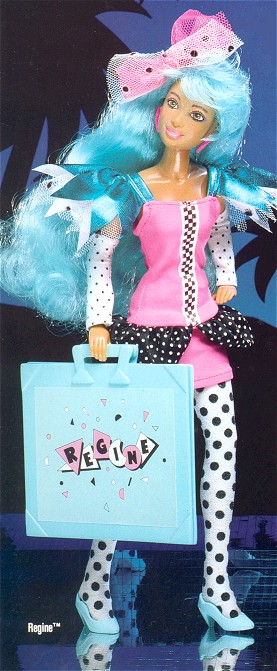
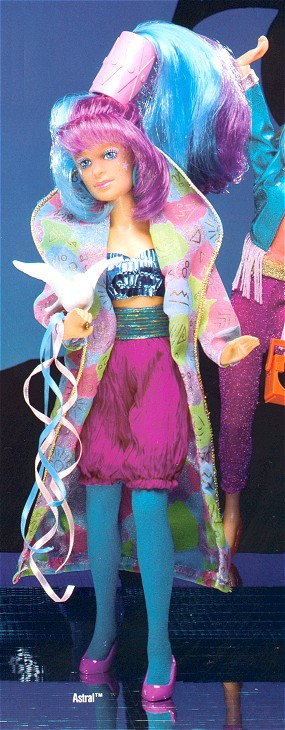
On top of the new band, there were also two other characters introduced,
Regine a fashion designer, and
Astral, a magician,
who were also based on Hasbro's planned dolls. Additionally there was a tagger, another
nuisance hanger-on to the Stingers and Misfits, that never got introduced,
Graphix.
And a bunch of new versions of Jem, Rockin' Romance Jem,
American Beauty Jem, and Hollywood Jem.
Unfortunately by the time the
episodes aired, Hasbro had already decided not to release any of the new dolls on the market.
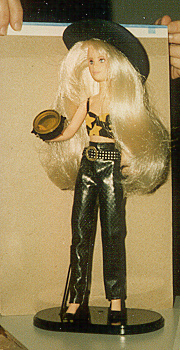
Fans have found pictures of some of the dolls in the
1988 Hasbro preview catalog, and additional pictures were sent out to
the cartoon writers for developing the characters.
There was even plans for a Jem movie at one point, as had been
done previously with Hasbro's other franchises G.I. Joe and Transformers. But with the poor results of
those movies, the
plans for the Jem movie didn't get beyond a basic outline by Christy. It was to include a couple of male/female
twins Alex and Alyx Couto which were a musicteam called the Mongrels and their synthesizer Entropy, a
masculine counterpart of Synergy invented by Techrat, which puts people in a form of trance.
|
||
|
With all it's outrageousness Jem dolls were apparently too different from other dolls
that had been around for a while. Jem was an actual character, a rockstar,
and on top of that she was far before her time with pink hair. Jem couldn't suddenly become a princess,
a ballerina, or a nurse, like Barbie. Hasbro tried solving this by introducing new characters.
Despite Hasbro's attempts with new ideas like the Glitter 'n Gold line, for which they even
used a codename "Ruby Red" to prevent other toy companies like Mattel from stealing
their ideas, Mattel's Barbie and the Rockers had already taken a big part of the market.
Other knock-offs were the pink-haired Spectra, also by Mattel, and Lace by Creata.
On top of that, all of the knock-off doll lines were cheaper than the Jem dolls.
The Jem dolls bigger size also meant that a lot
of other dolls clothes didn't fit the Jem dolls, and parents also didn't want
to spend their money on a new and more expensive format.
Apparently the Jem doll sales weren't what Hasbro had hoped for. The cartoon was
based on the dolls, and when the doll sales declined, Hasbro had no reason to continue backing a cartoon.
The last episode of Jem was aired on May 2 1988. Christy's opinion was that Hasbro gave up way too soon. She still feels that Jem is one of the best shows she has had the pleasure to be a part of, and that it was a wonderful experience. As for some of the other Hasbro/Sunbow shows at the time, they only lasted slightly longer, G.I. Joe made it to 86 episodes, while Transformers was cancelled after 111 episodes. Still they were considered a huge success.
Although Maxie had several things in common with Jem, as Hasbro used some of their ideas for Jem on Maxie instead, and even molds for dolls and accessories. Maxie was infact even planned to get her own rockband. But making a more conventional doll didn't do the trick, and after three years the Maxie line was cancelled having never reached the success of Jem. |
||
|
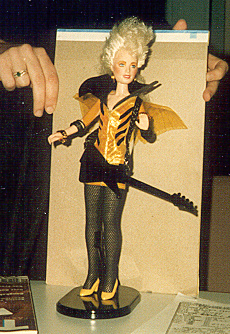
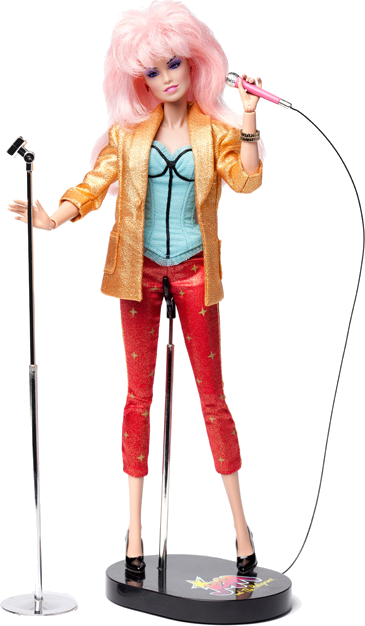
Then in June 27, 2012, it was finally time for an announcement, of the return of Jem in form of a doll!
Hasbro weren't making a line for the toystores though. Instead were approached by a wellknown
company of high fashioned dolls, Integrity Toys, for a commemorative doll line under the license of
Hasbro, resembling Jem as we
remember her from the 80's in a combination of the doll and cartoon look. The first doll, Hollywood Jem
was presented at the San Diego Comic Con International on July 12, where it reportedly sold out faster
than most exclusives. The commemorative doll line by Integrity Toys was a success! And more interpretations of Jem
and her friends continued to be released. The new line lasted over 10 years, alot longer than in the 80's, despite
the high prices of the new high quality dolls.
Also a new Jem comic series was created by IDW
Publishing, and an actual live-action Jem movie had it's premiere on October 23! Even exclusive Jem products like
clothing, jewelry, makeup, haircolors and new music! Jem fans are currently eagerly awaiting updates on what
else is to come.
|
||
| Back to index | About |
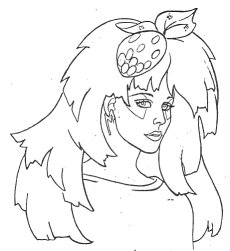
 Hasbro wanted realistic comic
book style interpretations of their dolls. They turned to the animation studio head Lee Gunther
[executive in charge of production on the Jem cartoon]. Gunther in turn asked the
head of the design team, William DuBay [art director at Marvel Productions
in 1984/'85, and art director on the Jem cartoon] for designs based upon Disney's old Snow White
animated feature.
William was shown prototypes of the Jem dolls by Hasbro, and took on
the exercise in futility. Knowing the designs were dated when DuBay was
producing the art, DuBay pretty much knew they weren't going to fly.
Rudy Nebres designed a second set of cels.
They pretty much knew that Rudy's designs wouldn't work either, since they were far
too complex to be animated. William even brought onboard
Paula La Fond [model designer on the Jem cartoon] to make a third set. Paula was the
leading female character designer of the day. So, when he brought her aboard, it was with
complete certainty that they would end up using her final designs.
Paula's designs were altered during the
presentation and faces (heads) DuBay created were added.
Hasbro watered down the faces until they compromised on what we saw as final on the screen.
Hasbro wanted realistic comic
book style interpretations of their dolls. They turned to the animation studio head Lee Gunther
[executive in charge of production on the Jem cartoon]. Gunther in turn asked the
head of the design team, William DuBay [art director at Marvel Productions
in 1984/'85, and art director on the Jem cartoon] for designs based upon Disney's old Snow White
animated feature.
William was shown prototypes of the Jem dolls by Hasbro, and took on
the exercise in futility. Knowing the designs were dated when DuBay was
producing the art, DuBay pretty much knew they weren't going to fly.
Rudy Nebres designed a second set of cels.
They pretty much knew that Rudy's designs wouldn't work either, since they were far
too complex to be animated. William even brought onboard
Paula La Fond [model designer on the Jem cartoon] to make a third set. Paula was the
leading female character designer of the day. So, when he brought her aboard, it was with
complete certainty that they would end up using her final designs.
Paula's designs were altered during the
presentation and faces (heads) DuBay created were added.
Hasbro watered down the faces until they compromised on what we saw as final on the screen.
 At this point, the name "Jem" was actually not yet in use yet. By may 30, 1985, Jem was still going to be
called "M", as in "Music", "Magic" and "Mystique" or even
"
At this point, the name "Jem" was actually not yet in use yet. By may 30, 1985, Jem was still going to be
called "M", as in "Music", "Magic" and "Mystique" or even
"
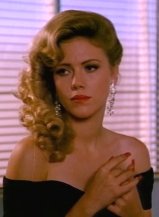 The speaking and singing of the characters in the cartoon, were not done by the same people.
The speaking voices were done by voice actors in Los Angeles,
while the singing was recorded by singers in New York.
The speaking and singing of the characters in the cartoon, were not done by the same people.
The speaking voices were done by voice actors in Los Angeles,
while the singing was recorded by singers in New York.
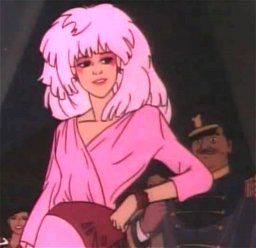 Jem began as a mini-series consisting of 15 segments that were each about 7 minutes long.
The first of these short segments were first shown on October 6, 1985, as part of "Super Saturday"/"Super Sunday", which
was a half-hour block that aired on various television stations along with other short segmented series
like "Bigfoot and the Muscle Machines", "Robotix", and
"Inhumanoids" each based on "boy-toys" and were very action-oriented.
Jem began as a mini-series consisting of 15 segments that were each about 7 minutes long.
The first of these short segments were first shown on October 6, 1985, as part of "Super Saturday"/"Super Sunday", which
was a half-hour block that aired on various television stations along with other short segmented series
like "Bigfoot and the Muscle Machines", "Robotix", and
"Inhumanoids" each based on "boy-toys" and were very action-oriented.
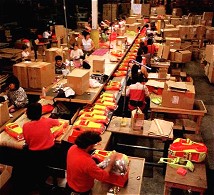 The Jem doll line was going to be the next big thing from Hasbro after their successful
toylines like Transformers, My Little Pony and G.I.Joe.
The
The Jem doll line was going to be the next big thing from Hasbro after their successful
toylines like Transformers, My Little Pony and G.I.Joe.
The 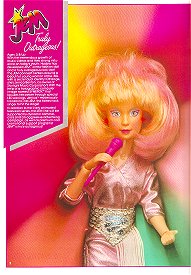 The colorful dolls, with their realistic bodyshape, creative fashions, and imaginative
playsets, were a hit!
The colorful dolls, with their realistic bodyshape, creative fashions, and imaginative
playsets, were a hit!
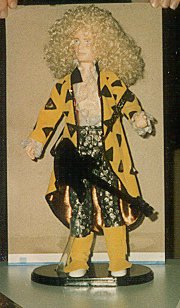 In the last season of the Jem cartoon, a bunch of new characters were introduced in the
episodes.
But instead of a new good or bad girlband with colorful haircolors, it was time for a mixed band with
only three members, and all had bright blonde hair. The Stingers weren't good or bad, not friends of the
Holograms nor the Misfits, but a new stand-alone group, that consisted of the male lead singer
In the last season of the Jem cartoon, a bunch of new characters were introduced in the
episodes.
But instead of a new good or bad girlband with colorful haircolors, it was time for a mixed band with
only three members, and all had bright blonde hair. The Stingers weren't good or bad, not friends of the
Holograms nor the Misfits, but a new stand-alone group, that consisted of the male lead singer
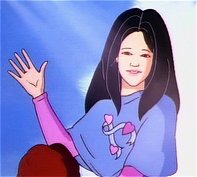 It's common to begin a TV-series with an order of 13 episodes,
then order another 13 = 26, and then if it does well, enough for 65, which is a standard
number of episodes for a full syndication order.
The 65th episode of Jem was approaching, and
when they got into the third season, the word finally came down
that the series would end, and
Christy had the rare opportunity to write what she knew
would be the final episode. It was 1988, and Christy had spent
three years of her life creating Jem. It was an emotional script for her to
write, and she was saying her own farewell through the voice of Ba Nee in the very last scene.
It's common to begin a TV-series with an order of 13 episodes,
then order another 13 = 26, and then if it does well, enough for 65, which is a standard
number of episodes for a full syndication order.
The 65th episode of Jem was approaching, and
when they got into the third season, the word finally came down
that the series would end, and
Christy had the rare opportunity to write what she knew
would be the final episode. It was 1988, and Christy had spent
three years of her life creating Jem. It was an emotional script for her to
write, and she was saying her own farewell through the voice of Ba Nee in the very last scene.
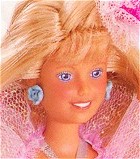 Apparently Hasbro wanted a doll line for the US market (they already had Sindy for Europe),
and decided to change some things from their Jem line, and make a second attempt.
So they created Maxie, a doll line consisting of a blonde high school girl and her friends.
The dolls were more similar to Barbie in size, and there was even a 32 episodes long cartoon show
called "Maxie's World" which even included some music.
Apparently Hasbro wanted a doll line for the US market (they already had Sindy for Europe),
and decided to change some things from their Jem line, and make a second attempt.
So they created Maxie, a doll line consisting of a blonde high school girl and her friends.
The dolls were more similar to Barbie in size, and there was even a 32 episodes long cartoon show
called "Maxie's World" which even included some music.
 Although Jem existed for primarily 3 years in the 80's, it certainly made a lasting impression, and gained
alot of loyal fans during that period. Since the mid 90's, and with the help of the internet,
Although Jem existed for primarily 3 years in the 80's, it certainly made a lasting impression, and gained
alot of loyal fans during that period. Since the mid 90's, and with the help of the internet,
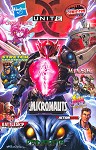
 In 2011, the entire animated series was finally released on DVD, Jem started airing
on Hasbro's new TV channel the Hub, and Jem appeared among other Hasbro characters in a Comic Con
exclusive comic book.
In 2011, the entire animated series was finally released on DVD, Jem started airing
on Hasbro's new TV channel the Hub, and Jem appeared among other Hasbro characters in a Comic Con
exclusive comic book.